PropertyCashflow Blog
Contact us at info@propertycashflow.co.uk or WhatsApp Click Here.

The Director's Profit Extraction Protocol (2025/2026): For UK Investors with a PAYE Job
Why the standard £12,570 salary is a tax trap and what to do instead.
Stop. If you run a limited company (especially for your property portfolio) and also have a separate PAYE job, the advice you're getting is probably wrong.
I see it every day. Well-meaning accountants who tell their clients to "take a £12,570 director's salary."
For a director whose only income is from their company, this is fine. For you, it's a strategic disaster.
You are leaking thousands of pounds in tax, and you probably don't even know it.
Why? Because that PAYE job has already used your £12,570 Personal Allowance. Every single pound you take as "salary" from your limited company is being taxed at your highest marginal rate—20%, 40%, or even 45% from pound one.
This is not tax-efficient profit extraction. It's just... extraction.
You need a protocol. This is it.
The Problem: "Total Tax Leakage"
Your goal isn't to minimise one tax. It's to minimise "Total Tax Leakage"—the combined sum of all taxes paid by both the company and you.
This includes:
• Corporation Tax (CT)
• Employer's National Insurance (NI)
• Employee's National Insurance (NI)
• Income Tax
• Dividend Tax
The £12,570 salary fails this test, because it triggers high Income Tax and Employer's NI (on the amount above £5,000) for no good reason.
The Real Optimal Salary: £5,000 (Not £12,570)
With the Personal Allowance off the table, your salary decision is no longer about Income Tax. It's about National Insurance.
• The £5,000 "Secondary Threshold": This is the magic number for the 2025/26 tax year. If you pay yourself a salary of £5,000, it costs the company £0 in Employer's NI and costs you £0 in Employee's NI. It is still a tax-deductible expense, so it saves your company 19% Corporation Tax (£950).
• The £6,500 "Lower Earnings Limit": The only time you should take more than £5,000 is if your main PAYE job pays less than £6,500. In that tiny-edge case, pay yourself £6,500 from your company. It will cost your company £225 in NI, but it will secure your State Pension credit for the year.
For 99% of you reading this, your optimal director's salary is £5,000. End of story.
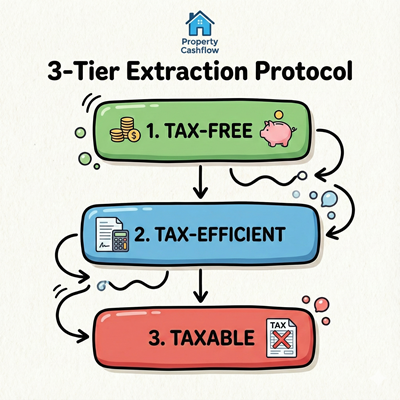
The 3-Tier Protocol for Tax-Efficient Profit Extraction
So, how do you get the rest of your money out? You follow this hierarchy. You must exhaust each tier before moving to the next.
Tier 1: Tax-Free Extraction (The "No-Brainers")
Extract these first. This is tax-free cash.
1. Reimbursable Expenses: Any money you spent personally for the business. Mileage (45p/mile), train tickets, etc.
2. Trivial Benefits: This is a gift from HMRC. You can give yourself £300 per year in non-cash benefits (like gift vouchers). Each one must be under £50. This is a tax-deductible expense for the company and 100% tax-free to you. If you're not using this, you're throwing away £300.
3. Use of Home Office: Claim the £312 per year (£6/week) flat rate. You don't need receipts. This is another simple, tax-free payment.
Tier 2: Tax-Efficient Extraction (The "Wealth Builders")
This is where you build real, long-term wealth.
• Employer Pension Contributions: This is the single most powerful tool you have. The company can pay directly into your personal pension. This payment is a 100% tax-deductible expense (saving 19%+ CT). You pay £0 Income Tax and £0 NI on it. It is a pure, tax-free transfer of company wealth to your personal wealth.
• Electric Vehicles (EVs): The Benefit-in-Kind (BiK) rate on pure-electric cars is just 3% for 2025/26. This means a £50,000 EV provided by the company would cost you just £600 in personal tax (if you're a 40% taxpayer). To buy that car personally, you'd need to extract over £75,000 in dividends. It's a no-brainer.
Tier 3: Taxable Extraction (The "Leftovers")
Only after you have maxed out Tiers 1 and 2 do you extract the remaining, post-Corporation Tax profit.
• Dividends: This is your final step. The company has paid its Corporation Tax, and now you pay personal Dividend Tax on what's left. Because your PAYE job and £5k salary have filled your basic rate band, you will be paying the 33.75% (Higher Rate) or 39.35% (Additional Rate). This is still significantly cheaper than taking it as a salary/bonus, which would cost you 40-45% Income Tax plus 2% Employee NI plus 15% Employer NI.
Critical Compliance Traps for Property Directors
Being a property director has specific, high-stakes traps. Ignoring them is catastrophic.
1. The ATED "Filing-for-Nil" Trap ATED (Annual Tax on Enveloped Dwellings) is a tax on residential properties worth over £500,000 held in a company. The annual charge starts at £4,450.
o The Trap: You might think "I run a rental business, so I'm exempt." You are. But the exemption is not automatic. You must file a "Relief Declaration Return" with HMRC every year by 30th April to claim your £0 tax bill.
o The Penalty: If you fail to file this "nil" return, HMRC considers you non-compliant. They can (and do) demand the full £4,450 tax, plus late filing penalties. This is a devastatingly simple mistake.
o External Link: Read the government's guidance on ATED basics here: https://www.gov.uk/guidance/annual-tax-on-enveloped-dwellings-the-basics
2. The Director's Loan Account (DLA) Trap This is not a tax-extraction strategy. This is a short-term cashflow tool, and it's dangerous.
o The Trap: If you "borrow" money from your company and don't repay it within 9 months and 1 day of your company's year-end, the company must pay S455 tax.
o The Penalty: The S455 tax rate is 33.75%—deliberately set at the same level as the high-rate dividend tax. It's a temporary tax, but it strangles your company's cash flow. Be aware of "bed and breakfasting" anti-avoidance rules, too.
o External Link: Understand the rules on Director's Loans here: https://www.gov.uk/directors-loans
Your Action Plan: Stop Leaking Tax
Don't be a passive business owner. Your tax strategy is your responsibility
1. Stop taking a £12,570 salary.
2. Start taking a £5,000 salary.
3. Implement the 3-Tier Protocol: Max out Trivial Benefits, Home Office, and Pension contributions before you take a dividend.
4. Check your compliance: Do you own a property >£500k? Set a reminder for your ATED return. Now.
This is the kind of strategic thinking that separates successful investors from busy fools.

Join thousands of investors getting our weekly Insights.
Investors Success Stories

My Most Recent Thoughts
By Noel Cardona
All blog posts

The £40,000 Property Challenge: Can You Actually Get an 8% Return?
PropertyCashflow BlogContact us at info@propertycashflow.co.uk or WhatsApp Click Here.£40k Property Investment: Getting an 8% Return.Someone sat across from me this week and asked a question that felt like a trap. "Noel, I have £40,000 and I want an 8% return. Can I do that without buying a dud?" It’s a…

Why I Don't Trust Contractors: How to Stop Losing Money on Repairs
PropertyCashflow BlogContact us at info@propertycashflow.co.uk or WhatsApp Click Here.Managing Property Contractors: How to Audit Work & Save Money.The question isn't "Will a contractor let me down?"The question is "When?"It is the most frustrating thing for me in property. You hire a professional, you pay the invoice, and you assume the…

Signature Group Collapse: The £140m Wake-Up Call for UK Investors
PropertyCashflow BlogContact us at info@propertycashflow.co.uk or WhatsApp Click Here.Signature Group Collapse: Lessons for UK Property InvestorsThe question is, what can we learn from failed companies that try to do their best in property investment, but circumstances—external or internal—make it impossible?Between 2020 and 2022, the UK property market witnessed a catastrophic…

Property Refurbishment Contingency: How to Stop Your Dream Project From Going Broke
PropertyCashflow BlogContact us at info@propertycashflow.co.uk or WhatsApp Click Here.Property Refurbishment Contingency: How to Stop Your Dream Project From Going Broke.When you are refurbishing a property, the question isn't if something will go wrong.The question is what will go wrong... and can you afford to fix it?I have seen investors lose…

Signature Group Collapse: The £140m Wake-Up Call for UK Investors
PropertyCashflow Blog Contact us at info@propertycashflow.co.uk or WhatsApp Click Here. Maximize Property Value: The 6 Levels of Strategic Investment Stop settling for average returns. Learn how to extract every penny of potential from your UK property portfolio. What is your single greatest responsibility as a property investor?Is it finding the…

How to Maximize Property Value: The 6 Levels of Strategic Investment
PropertyCashflow BlogContact us at info@propertycashflow.co.uk or WhatsApp Click Here.Maximize Property Value: The 6 Levels of Strategic InvestmentStop settling for average returns. Learn how to extract every penny of potential from your UK property portfolio.What is your single greatest responsibility as a property investor?Is it finding the lowest price? Is it…
The 5 Hats of Property Business: Stop Being an Operator and Start Investing
PropertyCashflow BlogContact us at info@propertycashflow.co.uk or WhatsApp Click Here.The 5 Hats of Property Business: Stop Being an Operator and Start InvestingIn the property business, there is a trap that catches almost everyone.It isn't interest rates. It isn't bad tenants. It isn't even the government.It is you.Specifically, it is how you…

23 Essential Strategies to Future-Proof Your UK Property Portfolio
PropertyCashflow Blog Contact us at info@propertycashflow.co.uk or WhatsApp Click Here. 23 Long-Term Property Investment Strategies for UK Investors Property investment is a long-term game. We all know this, yet most investors play with a short-term mindset. They chase the next deal, the quick flip, or the immediate cash flow, completely…

Asbestos in UK Property: How to Avoid a £20,000 Refurb Nightmare
PropertyCashflow Blog Contact us at info@propertycashflow.co.uk or WhatsApp Click Here. 16 HMO Refurbishment Strategies for Hands-Off Property Management Imagine getting a call that there is a leak in your six-bedroom HMO. Usually, this means an emergency plumber, shutting off water to the entire house, and six angry tenants who can’t…

16 HMO Refurbishment Strategies for Hands-Off Property Management
PropertyCashflow Blog Contact us at info@propertycashflow.co.uk or WhatsApp Click Here. 16 HMO Refurbishment Strategies for Hands-Off Property Management Imagine getting a call that there is a leak in your six-bedroom HMO. Usually, this means an emergency plumber, shutting off water to the entire house, and six angry tenants who can’t…
Join over 3,000 investors getting out weekly Insights
The Property Renegade will always stay alert of what is happening in the market!
PropertyCashflow Blog
Learn, Invest, Retire
Copyright © Property Cashflow Ltd. All Rights Reserved