The 10 Most Important Trends in UK Property Investing in 2026: Strategic Outlook
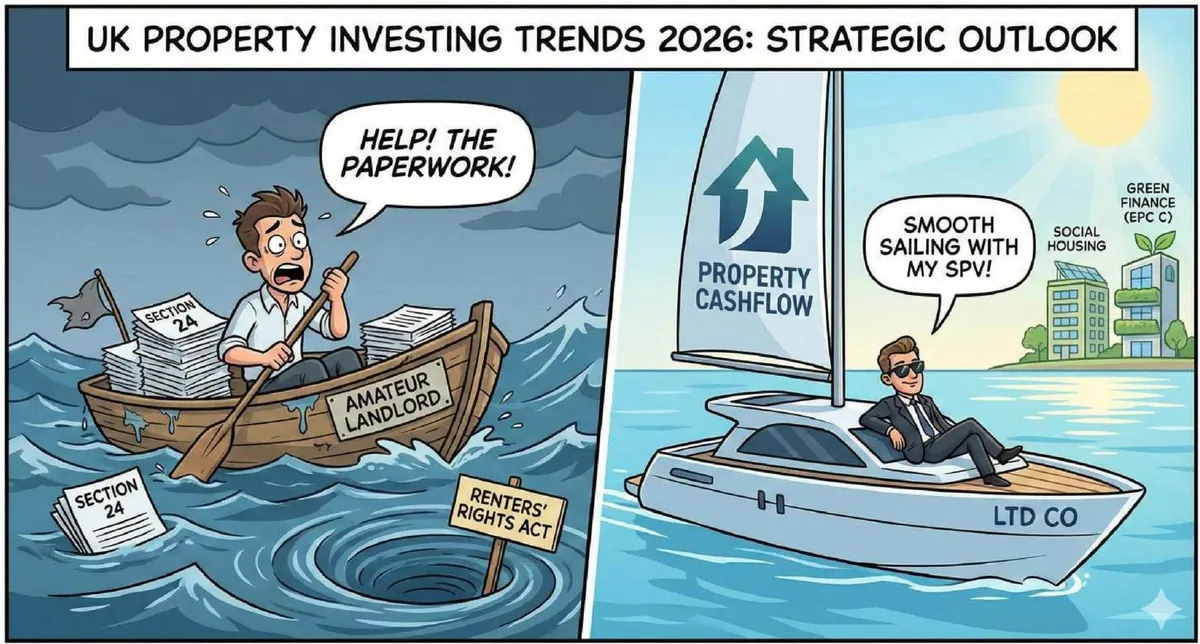

The UK property market in 2026 is characterized by a profound structural bifurcation. On one side, the traditional, amateur-led private rented sector (PRS) is contracting, driven by an aggressive fiscal and regulatory environment. On the other, a sophisticated, professionalized investment tier is expanding rapidly.
If you are still operating with the “buy and hold” mindset of 2010, you are in trouble. This analysis will break down exactly why the game has changed and how you must adapt.raph
The Problem: The End of the “Accidental Landlord”
For decades, being a landlord was easy. You bought a house, the tenant paid the mortgage, and capital appreciation made you rich. That model is broken.
The combination of Section 24 tax restrictions (taxing turnover instead of profit) and interest rates settling has eroded the margins of personal-name ownership. If you are a higher-rate taxpayer, you could be making a loss in real terms while still paying tax.
The Corporatization of the PRS
The most significant shift leading into 2026 is the mass migration of assets into Limited Company vehicles.
• The Data: There are now over 400,000 companies holding buy-to-let property—a massive increase.
• The Reason: Limited companies pay Corporation Tax on profits, allowing you to deduct mortgage interest as a cost. This is essential for portfolio growth.

The Regulatory Revolution: Renters’ Rights Act
The Renters’ Rights Act has fundamentally rebalanced the power dynamic.
• No More Section 21: “No-fault” evictions are abolished.
• No More Fixed Terms: All tenancies are periodic from Day 1.
This terrifies the amateur, but it empowers the professional. The focus must shift from “eviction” to “selection.” Advanced tenant vetting and Rent Guarantee Insurance are no longer optional; they are your primary line of defense.
The Strategy: Emerging Asset Classes
Where is the smart money going?
1. Social Housing Supported by the government’s “Decade of Renewal,” Social Housing leases offer guaranteed income (often 5-10 years) backed by the state. It is a defensive play against economic volatility.
2. Co-Living This is not just an HMO. It is a hospitality-led product targeting young professionals who value community and amenities over square footage.
3. Green Finance With the mandate for EPC ‘C’ ratings reinstated, “Brown” buildings (rated D-G) are trading at a discount. The strategy? Buy Brown, Make it Green, Refinance Cheap.
Key Takeaways
• Corporatize: Move assets to SPVs to survive Section 24.
• Professionalize: Adapt to the Renters’ Rights Act with rigorous due diligence.
• Diversify: Look at Social Housing and Co-Living for security and yield.
• Go North: The yield gap between the North (8%+) and London (3-4%) is widening.
Reflection & Call-to-Action
These trends are not doom-and-gloom; they are a roadmap. The opportunities are huge for those willing to treat property as a business, not a hobby.
Are you winning the game, or are you just playing?
Download our Free book: The 12 most powerful ways of Making Money in UK property by going to Property Cashflow Book Offer
Take the Test: What type of investor you are: Take the test “What type of investor are you?” take this complimentary yet extensive test to understand your Financial IQ, Your Risk Level, and whether you are winning the game or not. Go to Investor Profile Test

Find out what type of investor you are. Take the free investor test to see your real risk profile, then grab the free book with the 12 most powerful ways of making money in UK property.