
Cash Flow vs. ROI: The Single Most Important Number in UK Property
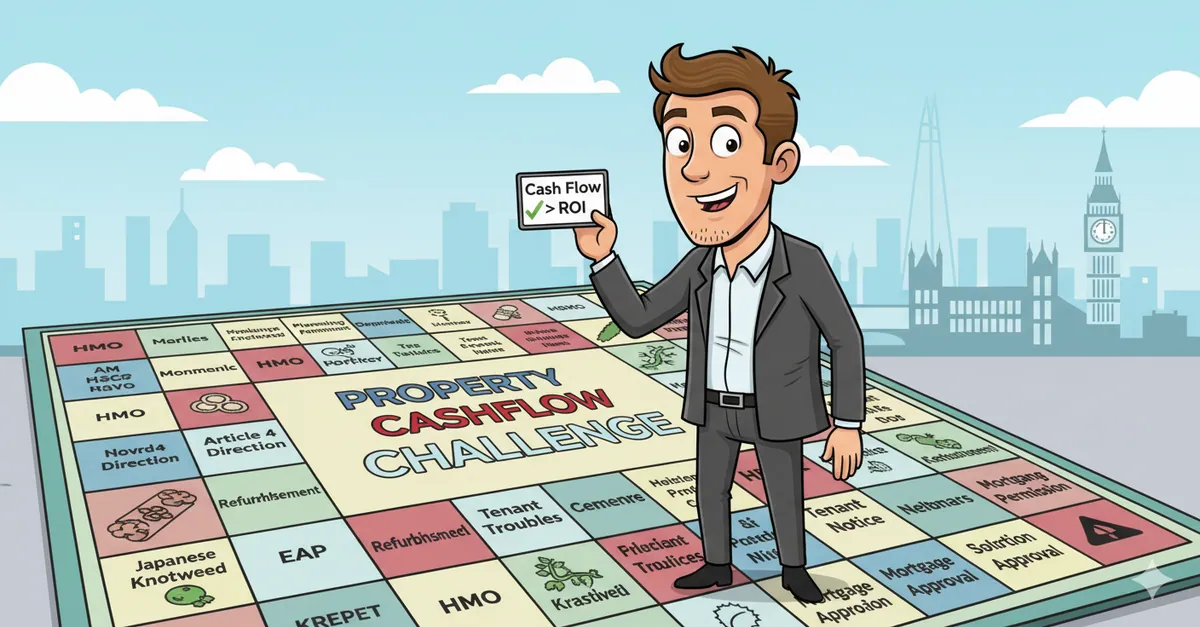

Cash flow is the money left in your account each month after the rent has paid the mortgage interest, management, insurance, maintenance, ground rent, utilities, tax and a realistic allowance for voids. ROI is the return you earn on the capital you actually put in. They answer two different questions, and a deal can look excellent on one and quietly sink you on the other.
That is the whole problem in a sentence. Most investors are sold on ROI, because ROI is the number that sounds impressive in a brochure. But ROI is a score awarded at the end of the year. Cash flow is what pays the boiler engineer in February.
The two numbers, defined properly
Cash flow is simple arithmetic, and it is monthly. Take the rent actually collected. Subtract every real cost: mortgage interest, letting or management fee, buildings insurance, licensing, service charge, ground rent, gas and electrical safety certificates, repairs, the utilities you cover, and the weeks each year the property sits empty. Whatever remains is your cash flow.
ROI is a ratio, and it is annual. Take your annual net profit and divide it by the total capital you have tied up in the deal — deposit, stamp duty, legal fees, survey, refurbishment, furnishing and the holding costs you paid before the first tenant moved in. Multiply by a hundred. That is your return on investment.
Notice what each one ignores. Cash flow says nothing about how much money you had to sink in to get it. ROI says nothing about whether the money arrives in time to pay the bills.
Why a strong ROI can still fail
Here is the trap. A property bought cheaply, refurbished well and revalued upward can show a superb ROI — sometimes an infinite one, if you pulled all your capital back out on refinance. On paper you own an asset that cost you nothing. It is the story every course sells.
But pulling your capital out means borrowing more against it. More borrowing means a larger monthly interest bill. The ROI stays beautiful, because your invested capital is near zero. The cash flow, meanwhile, has been squeezed to nothing, and it is now one interest rate rise or one three-month void away from negative.
A portfolio does not fail because its ROI was too low. It fails because it ran out of cash.
A worked example
Take a £150,000 terrace let at £850 a month, bought with a 25% deposit. Gross rent is £10,200 a year. Say interest costs £4,700, management and letting fees £1,100, insurance and compliance £500, repairs and maintenance £900, and you allow two weeks of void at £390. Annual net profit is about £2,610 — roughly £217 a month.
Your capital in is £37,500 deposit plus around £6,500 of stamp duty, legal fees and survey, plus a £4,000 tidy-up: £48,000. That is an ROI of about 5.4%.
Now the same house with the capital refinanced out. The mortgage is bigger, so interest rises to perhaps £7,600. Net profit drops to around £-290 a year. Your capital in is nearly nil, so the ROI is spectacular and meaningless. You now own a property that costs you money every month to keep.
Same house. Same tenant. Same rent. Two completely different businesses.
Read them together, in this order
Assess cash flow first, because it is the survival test. If the deal does not produce a positive monthly figure under honest assumptions, nothing the ROI says will save it. Only then look at ROI, to decide whether this is the best home for your capital compared with the next deal on your list.
Be honest in the assumptions, too. Most projections that fail do so not because the investor did bad maths but because they used optimistic inputs: no voids, no repairs, a management fee they were never going to pay because they planned to do it themselves and then did not. If you want a sense of what realistic numbers look like across a whole portfolio, the £450k question is worth reading alongside this one, and the £40,000 challenge puts an 8% target under the same honest pressure.
What changes the answer in 2026
Two things are worth building into any forecast you make now. From 6 April 2027 the government has legislated separate property income tax rates of 22% basic, 42% higher and 47% additional in England, Wales and Northern Ireland. They are not the rates that apply today, but they will apply within the life of a deal you buy this year, and they land on net profit — which is to say, on your cash flow. The Budget analysis sets out the detail.
The second is regulatory. The Renters’ Rights Act 2025 began its first private rented sector phase on 1 May 2026, including the end of Section 21. Longer, less predictable possession timelines mean void assumptions that were reasonable three years ago are no longer conservative. Build in more, not less.
And do not forget the costs that never appear in a listing. Council tax between tenancies and repair bills you did not audit have emptied more cash flow forecasts than interest rates ever have.
The short answer
ROI tells you whether a deal was worth doing. Cash flow tells you whether you can afford to keep doing it. If you only ever track one number every month, track the second one — and check the first once a year, when you decide where the next pound of capital goes.

Find out what type of investor you are. Take the free investor test to see your real risk profile, then grab the free book with the 12 most powerful ways of making money in UK property.

academyfinancial freedominvestmentsmarket analysis trendsmindset