Flat 1, Flat 2, Flat 4: What a Listing Discrepancy Is Telling You
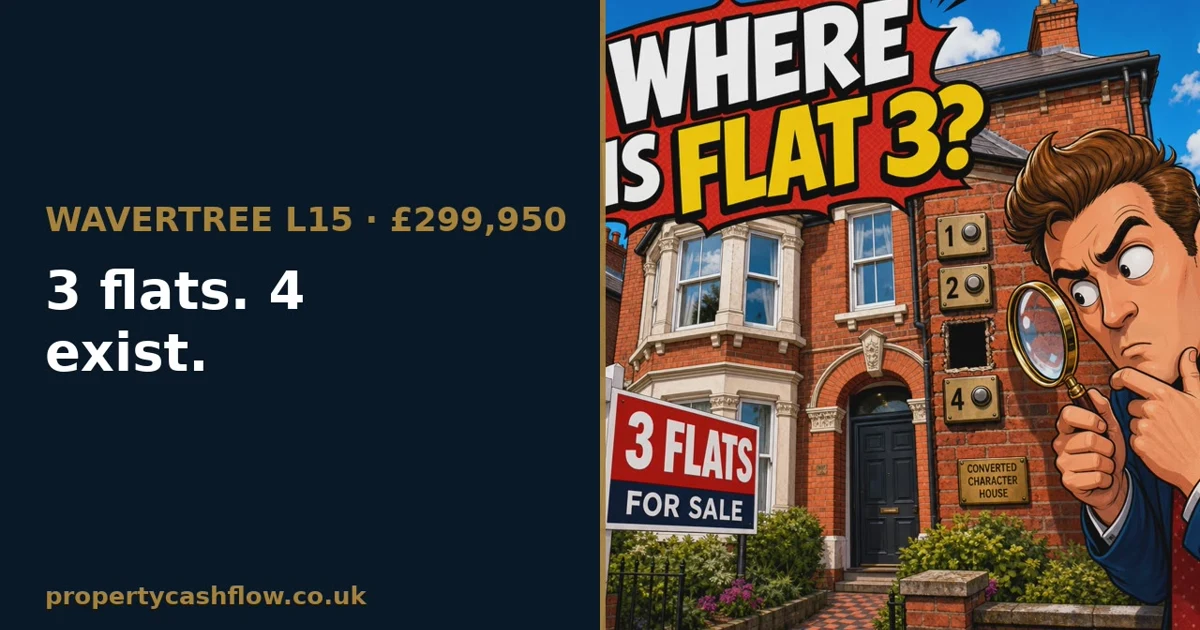

25 North Drive, in Wavertree, is advertised as three flats in one title at £299,950. The three are flat 1, flat 2 and flat 4.
Read that again. One, two, four.
Something I have learned from looking at hundreds of properties every week is that many of the best opportunities are hidden behind a discrepancy that nobody has bothered to explain. Not a bargain announced in the price. A gap in the paperwork that makes the whole thing look slightly wrong.
So where is flat 3?
I checked the national register, and it exists. Which means the building holds four flats, and either one of them is not in the sale, or the advert is wrong about what you would be buying. Those are very different propositions, and the listing does not tell you which one you are looking at.
That is not the only thing that does not line up. The description says three flats within one freehold title. The tenure field, on the same page, says leasehold. And the lease length quoted, 108 years, is attributed to flat 3 — the flat that is never described anywhere in the advert.
So either the titles were split and three flats sit on one freehold with the fourth held separately, or four flats are actually being sold and somebody has made a mistake. I do not know yet. I will find out.
Then there is the income
"Annual rental income standing at £26,400."
The three flats are listed at £650, £700 and £850 a month, which is exactly £26,400 a year. But all three are empty. Nothing is standing. That is a projection with a confident word in front of it, and a projection on an empty building is a very different thing from a rent roll you can verify.
And near the bottom, the agent discloses an offer already received: £250,000, against that asking price of £299,950.
Why show you a listing I have not got to the bottom of?
Because this is what the work actually looks like. Not a tidy case study with a number at the end, but four things that do not agree with each other and a morning spent finding out which of them matters.
And because of what happens next. Most people see a mess like this and scroll straight past it. The numbering looks like a mistake, the tenure looks confused, the income does not stack up, so they move on to a listing that is easier to read.
Sometimes that is the most valuable part of the listing. Because it is not there, or it is not very well explained, many people let them go, and there is less competition.
The discrepancy is not the reason to walk away. It is very often the reason there is still something left to buy.
What I said in the video
Something I have learned from looking at hundreds and hundreds of different properties every week is that, incredibly enough, many of the opportunities, and this is not uncommon, many of the best opportunities in the market are basically hidden, or pointed to by some discrepancies that sometimes you do not understand. And that is where, by doing a little bit of digging, you might find some jewels.
I want to show you an example. This might not be a jewel, but it is an example of discrepancies which may bring you very big returns. This is a house that was turned into flats some time ago, and the property is being sold as three flats. But you can see it is flat one, two and four. There is a third flat, which I just confirmed with the national register. So it is four flats.
But the discrepancy is that the tenure here is leasehold, and then the description is three flats within a character property purchased within one freehold title. So it is interesting to know whether this property actually split the titles, and there are three flats on one freehold title and then another one on a different title. Or, for some reason, they are actually selling four of the flats and there is a mistake here. I do not know. I will find out, and I will learn about this, and we might end up buying this property.
But what I wanted to say is exactly that. The discrepancies. Sometimes it is pictures, sometimes it is this kind of description, sometimes it is things that are not very much right, sometimes it is the layout, sometimes it is things that are left out of the listing and that you find out later on.
Sometimes that is the most valuable part of the listing, and it is what signals a very good opportunity. And sometimes, because it is not there or it is not very well explained, many people would let them go, and there is less competition. So hopefully this is one of them. We will have a look.
Questions people ask about this
Why would a listing skip a flat number?
Usually because that flat is not part of the sale, and occasionally because the advert was written from an old set of particulars and nobody checked. Neither is sinister on its own, but they lead to completely different deals, so you need to know which before you offer. The land registry will tell you what titles exist at the address and who owns them. If a flat exists that the seller is not selling, you are buying into a building you do not control, and that changes the management, the insurance and the exit.
Can a property be freehold and leasehold at the same time?
A building can, and this is where the confusion usually comes from. A converted house typically has one freehold title for the whole building and a long leasehold title for each flat inside it. So an advert saying "three flats within one freehold title" and a tenure field saying "leasehold" may both be describing something real, or the listing may simply be wrong. Ask the agent which titles are included, by title number, and check them yourself rather than accepting a summary.
What does "annual rental income standing at" actually mean?
It should mean rent that is actually being collected today, from tenants who are actually in place. On this listing it means the three advertised rents added together while all three flats sit empty. That is a projection, and the word "standing" is doing work it has not earned. Always ask whether a quoted income is achieved or estimated, and for a tenanted property ask for the tenancy agreements and the rent statements before you rely on the figure.
Are messy listings worth pursuing?
Often, yes, and that is the whole point of this one. A listing that is hard to read filters out most of the buyers who would otherwise be competing with you. That is not the same as saying the property is good. The mess is a reason to look harder, not a reason to relax. You still have to do the work and find out what is actually there, and you still have to be willing to walk away when the answer is bad.
What to do with this
Next time a listing does not quite add up, do not close the tab. Write down exactly which two things disagree, and then go and find out which one is true. That single habit is most of what separates the investors who find things from the investors who read about them afterwards.
And if you want the calculators and tools I use when I start pulling a listing apart, that is what the UK Property Investor Toolkit is. Fifteen tools, and it is 99p, which is just the shipping for the physical toolkit we post out to you.