The Source Code of Value: Your Step-by-Step Guide on How to Convert a House into Flats in the UK for Maximum Property Cashflow

Multiplying Your Asset Value
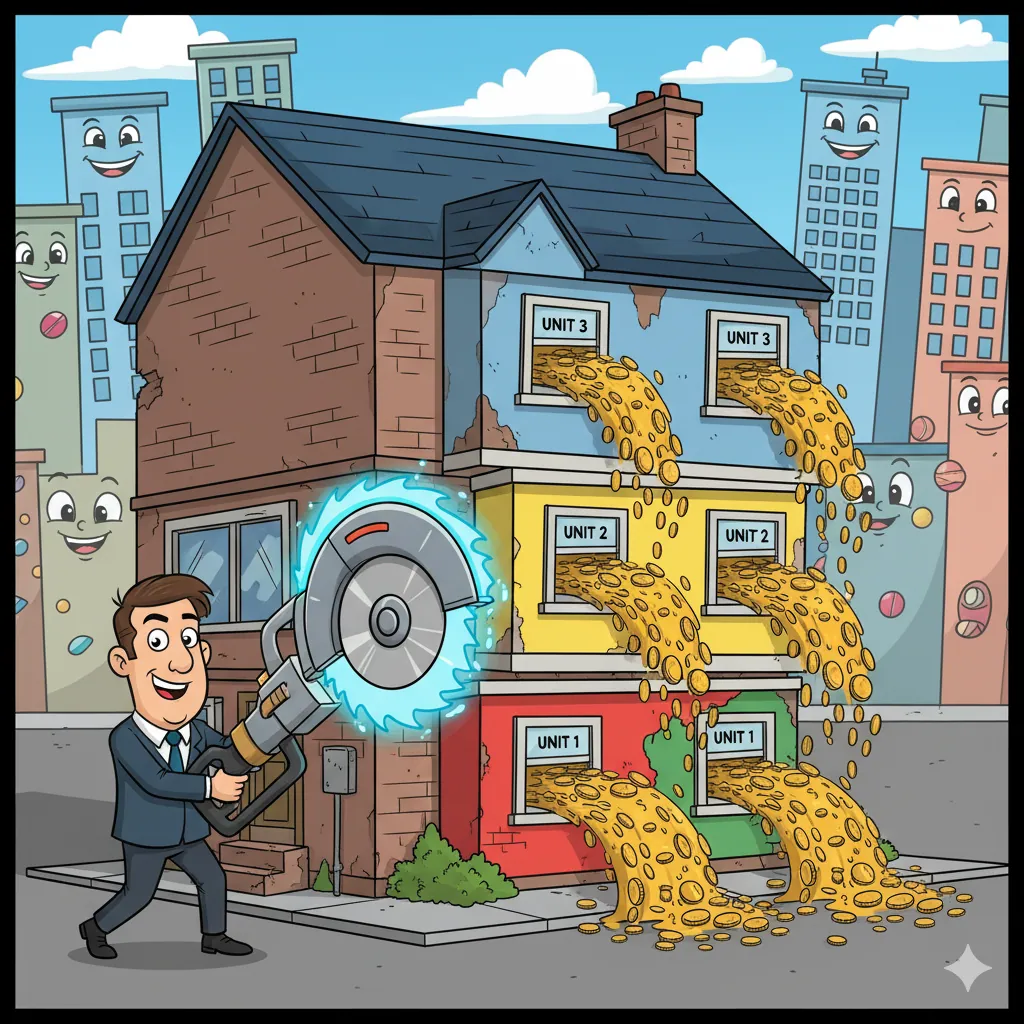
In the UK property investment game, a large single-let house offers one stream of income. A house to flats conversion UK, however, offers two, three, or even four distinct income streams from the same footprint.
This strategy is often called the “vertical growth” model. It allows you to meet the high demand for smaller, more affordable dwellings while simultaneously generating exponentially higher Property Cashflow than a traditional Buy-to-Let (BTL).
This strategy is complex and carries higher regulatory risk than simple refurbishment, but the rewards—a dramatic increase in asset value and yield—are worth the effort. Here is your practical guide to navigating the four critical phases of a successful house to flats conversion UK.
Phase 1: Feasibility and Due Diligence (Can It Be Done?)
Before you hire an architect or secure finance, you must confirm that the property and the location are viable.
1. Physical Constraints and Space StandardsYour biggest limitation is space. There are strict national minimum space standards that apply to new dwellings (which a new flat counts as).
● Action: Ensure the existing building’s footprint can accommodate the required floor area for your target number of flats, including communal access points. You need space for separate entrances, stairwells, and utility cupboards.
● Physical Test: For a two-person dwelling, you typically need a minimum of 50 sq. metres (GIA). Less space means fewer flats, which may kill the deal’s profitability.
2. Local Authority Check (Planning Policy)Local councils often have specific policies regarding the house to flats conversion UK to prevent over-densification.
● Action: Check the Local Plan for any guidance against dividing properties in your target area. Pay attention to parking provision—councils often refuse conversion if it exacerbates existing parking problems.
3. Utility InfrastructureA house has one set of meters; a block of flats needs individual metering.
● Action: Get early quotes from utility companies (electricity, gas, water) for providing separate supplies and meters to each new unit. This can be surprisingly costly and requires a dedicated plant room or external boxes.
Phase 2: Planning and Compliance (The Legal Hurdles)
This is the phase where amateurs fail. You need specialist advice to navigate the crucial distinction between a house and multiple dwellings.
1. Planning Permission: The Change of UseYou need Planning Permission to change the use of the building from a single dwelling (C3) to multiple self-contained flats (sui generis or C3(a)).
● Action: Engage an architect or planning consultant with a proven track record of successful conversions in your target area. Your application must demonstrate compliance with local planning policies regarding amenity, parking, noise, and design.
2. Building Regulations: Safety is Non-NegotiableConverting a single house into multiple flats fundamentally changes the property’s safety requirements.
● Action: You must meet stringent Building Regulations for fire safety (fire separation between flats, fire doors, alarms), sound insulation (to prevent noise complaints), and structural integrity. This requires comprehensive architectural drawings and sign-off from your local Building Control Officer.
3. Leasehold StructureUpon completion, each unit will legally become a separate flat.
● Action: You will need a specialist solicitor to draft the leasehold agreement for each unit and create a Head Lease for the entire building. This defines service charges, maintenance responsibilities, and ground rent.
Phase 3: Finance and Profit (The Ultimate Test)
The financing for this complex strategy is commercial, not residential. Your profit depends on the final valuation.
1. Specialist Finance for Acquisition and Build
A standard BTL mortgage is not applicable for a development project of this scale.
● Action: Secure Bridging Finance or a Development Finance loan to cover the purchase and 100% of the build costs. These are short-term loans with higher interest but offer the flexibility needed for quick execution.
2. The BRRRR Exit Strategy
The only way to achieve high Property Cashflow and recycle your capital is by completing the conversion and refinancing the finished flats.
● The Goal: The total market value of the completed flats (often valued based on their collective rental income, known as Investment Valuation) must significantly exceed your total project costs (purchase + build + finance fees).
● The Equation: Target a final valuation that allows you to refinance (typically 70-75% LTV) and pull out 100% of your original cash investment. If you can’t hit this target, the conversion is not a viable BRRRR deal.
3. Profit and Yield Calculation
A successful conversion often transforms a 5% gross yield into a 12-15% Property Cashflow yield.
Mastering the house to flats conversion UK is the ultimate value-add strategy for property investors in 2025. It moves you out of the competitive BTL market and into the high-yield development space.
The key to success is specialist knowledge, a robust financial model, and zero compromises on Building Regulations and Planning Permission. By approaching this strategy with professionalism and due diligence, you can dramatically accelerate your wealth growth and achieve superior Property Cashflow for decades to come.
Ready to take on your first complex conversion but need expert guidance on the finance and planning stages?
The team at Property Cashflow specializes in structuring and managing house to flats conversion UK projects. We connect you with specialist planning consultants, commercial lenders, and contractors to de-risk your project and maximize your final valuation.
We have extensive experience in high-yield conversion zones across Liverpool and Wirral.
Stop getting one stream of income. Start multiplying your cashflow.
Contact us today for a strategic consultation on your conversion project’s feasibility: Email: info@propertycashflow.co.uk

Find out what type of investor you are. Take the free investor test to see your real risk profile, then grab the free book with the 12 most powerful ways of making money in UK property.